

The week you just had,
kept.
Here is a working week. A scope decision in ChatGPT. A fix worked out in Cursor. A note in Obsidian, a calendar move, something worth keeping from email. By Friday it is scattered, and by next month most of it is gone. This page is what changes: the features below are the ordinary moments of that week, and what each one turns into when the memory is shared.


Claude does not know what you told Cursor.
The briefing you gave ChatGPT on Monday is there when Cursor needs it on Thursday, source attached. A decision you worked out in March is still answering questions in July. Nothing gets re-explained.
One MCP address; every client reads and writes the same brain.
See how clients connectSee the record of this site’s own build
Every memory tool waits for you to ask. This one speaks up.
Say “send the form by Friday” in whichever tool is open right now: Claude, ChatGPT, a voice note. Second Brain remembers it, keeps track of it, and lets you know when it is actually due. Open the notification, see the memory, and mark it done or push it to tomorrow.

Push notifications come from your own Worker, not a third-party service; nobody else ever holds your reminders.
Read how reminders workYou know you saved it. You can’t remember how you put it.
Ask for what you meant rather than what you typed, and the note turns up. The version of a fact you need most, usually the latest, ranks first, and old versions stop drowning it out.
Semantic search over stored meanings, with time-decay reranking.
Read how recall worksYou can't paraphrase a ticket number.
Recall finds the hard things: a name, a ticket number, a version like v1.9, a phrase in Japanese, Chinese or Korean, even in a memory from months ago. Finding them is faster and far cheaper than before, and stays that way as the brain grows, so a bigger brain doesn’t slow down the searches that matter most. Nothing to do either: the upgrade lands on its own, and an existing brain catches up over some nights.
A full-text index answers the search instead of reading every memory each time.
See how search worksYou asked, and got back a pile of links.
Ask a real question and the answer is built from what you actually stored, with the memories that support it listed underneath. Open any of them and check it against the source.
Recall and synthesis run on Workers AI inside your account.
See the dashboardThe meeting moved. Now your notes disagree.
Here is what happens when a fact changes underneath you.
 Saved
SavedStandup is Thursday, 10am.
SavedStandup moved to 3pm, in room B.
RecalledStandup is Thursday at 3pm, in room B.
The newer update wins the answer. Monday’s original time stays in the record, not the response.
Captures are compared by meaning before storing: 85 to 95 per cent similarity goes to a merge decision, 95 and above is blocked.
Read how conflicts are settledThe thought arrived in the wrong app.
Save it where it happened: the terminal, the share sheet, the bookmarklet, the Obsidian plugin. Calendar and inbox sync read-only, so the week’s movements land by themselves.
Capture surfaces from the terminal to the share sheet, all writing to one store.
See every capture surface and sync sourceWhere did that come from?
Each memory shows where it was saved from, and a hint appears when a fact may have gone stale. High-importance entries are protected from being quietly overwritten.
A source field on every capture, and a staleness pass over the store.
Read the source and staleness fieldsThe same theme keeps turning up.
Threads that recur across what you have stored surface as patterns, and a weekly note gathers them. You stop compiling your own themes by hand on a Sunday evening.
Pattern derivation runs after every search; insights ship weekly.
See weekly insights in the dashboardYou have abandoned tools like this before. Setup was the reason.
The desktop app asks for a Cloudflare login and a password, then provisions the database, the vector index and the Worker, and wires up Claude Code and Cursor. About two minutes. No terminal.
Signed builds for Mac and Windows; the app can update the deployed Worker in place.
Read the setup guideEach project
in its own place.
A brain that keeps everything gets hard to browse. Give the website, the client and the kitchen a project each, and a memory can say what it is about. Open a project and you see only what belongs to it, with a summary of where it stands.
Your AI tools use projects too. They can list yours, file what they save under the right one, and ask for one project’s memories only. Name a project that does not exist yet and it is created on the spot, so saving never stops to ask.
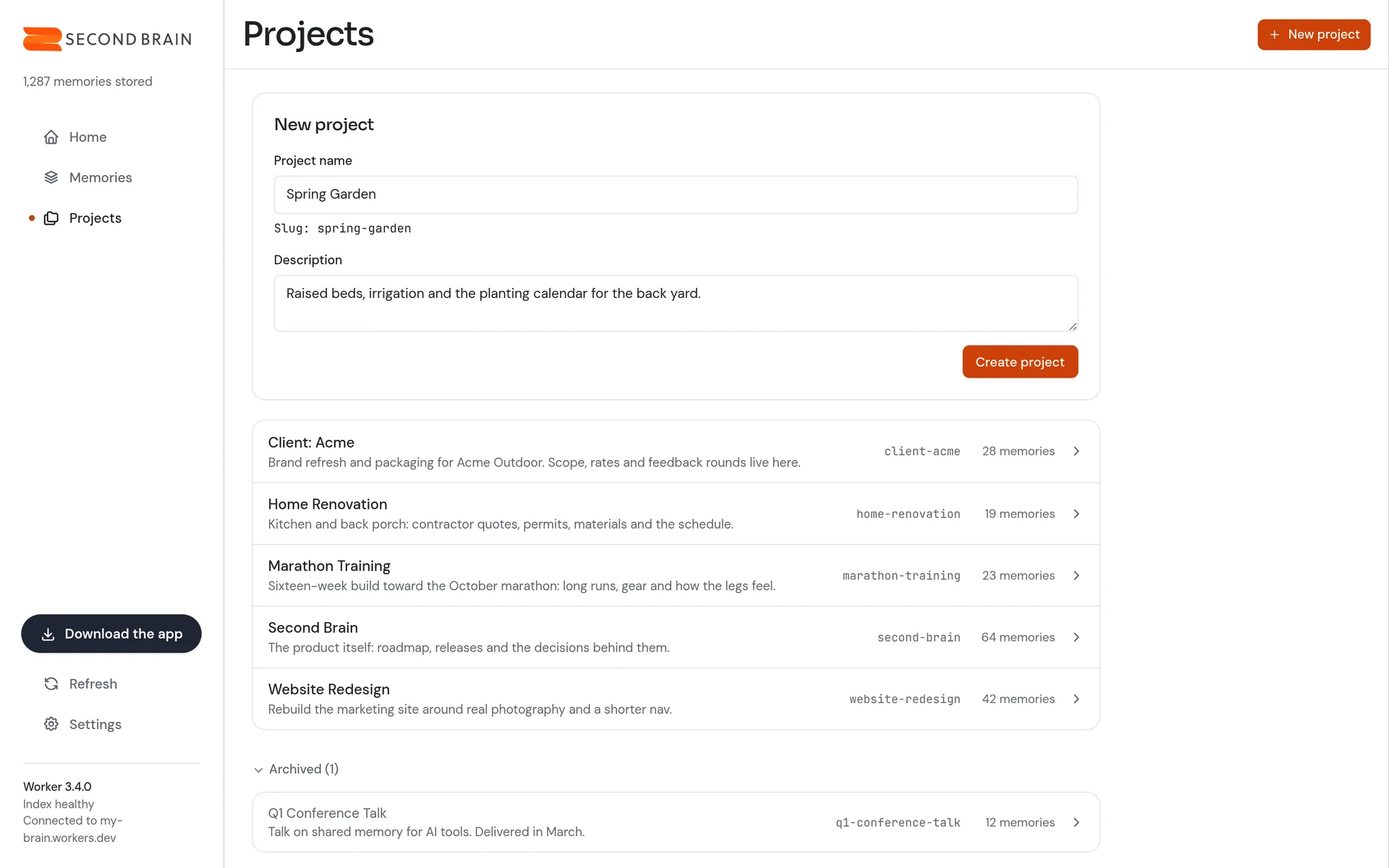
Every memory answers four questions.
- Workspace
- Who can see it. Personal, or your team’s shared layer.
- Project
- What it is about. A named home, like Website Redesign.
- Tags
- Anything else worth filtering on. As many as you like, in your own words.
- Source
- Where it came from. Claude, Cursor, email, the terminal.
You do not have to start over. If you have been tagging notes acme since last spring, add acme to the client’s project as an alias and every one of those notes belongs to it. Nothing is retagged. Nothing is migrated.
A project is a reserved project:slug tag on ordinary memories, so search, summaries, the graph and every filter already understand it. Nothing is re-indexed.
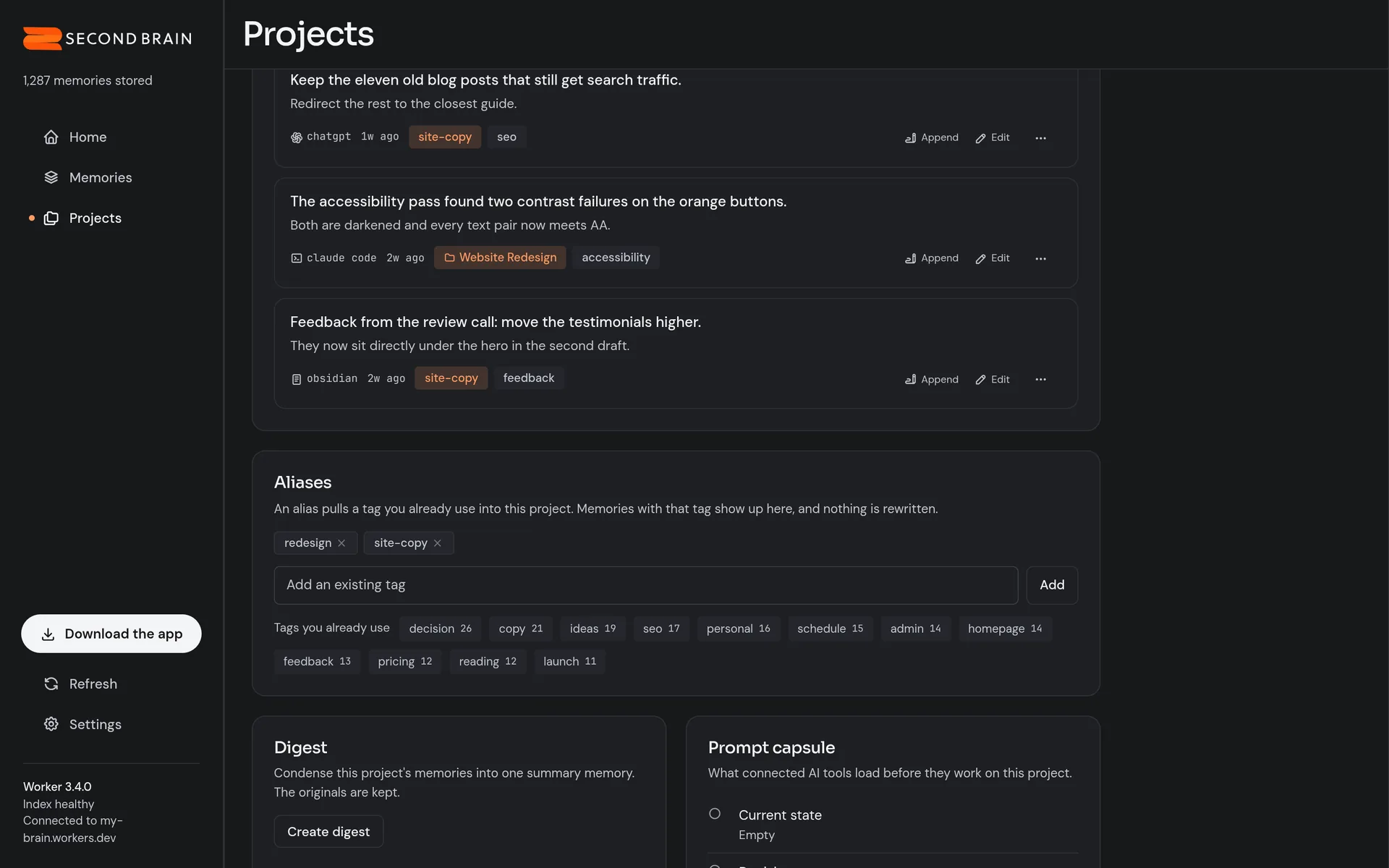
Finish a project and archive it. It leaves the pickers and the nightly summaries, and you can undo it. Delete one and every memory stays. Only the grouping goes, and creating the project again brings the memories back.
Read how projects work
Shared on purpose,
private by default.
Team Edition runs on the same Worker as the personal brain, the same deployment and no extra charge, and nothing is shared until someone shares it. Each person has two layers: a personal layer nobody else can see, search or reach through any client, and the shared layer everyone on the team reads.
Sharing moves the memory itself, one entry with one history, not a copy, and it can be moved back; once shared, only its author or an admin can change, un-share or delete it.
Admins manage members and roles and review an activity feed of every add, share and removal. What they cannot do is read anyone’s personal layer, the owner’s included. For offboarding they see a count of a person’s private memories, never the content.
Limits. One shared team per brain in v3.0.0, with no enforced size limit; the practical ceiling is your Cloudflare plan’s budgets. A personal brain becomes a team brain when a second person joins: existing memories are filed into your personal layer and nothing is shared automatically.
Start with your own week.
Two minutes, your Cloudflare account, free and MIT-licensed forever. There is no paid tier, and no paid team tier either.